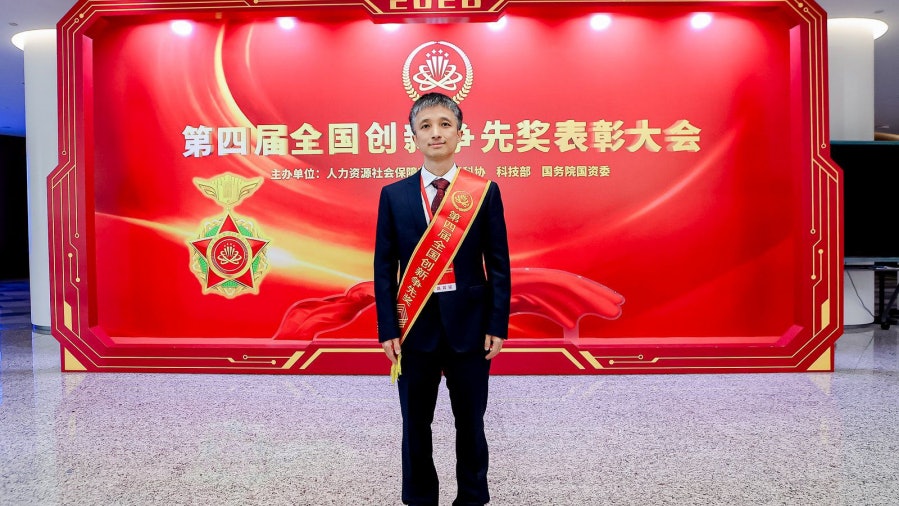
The HK Institute of Quantum Science & Technology (HKIQST) proudly congratulates our esteemed fellow Professor Yao Wang, on receiving the Certificate of Merit at the Fourth National Award for Excellence in Innovation. This esteemed accolade honors Professor Wang’s remarkable contributions to valley optoelectronics in two-dimensional semiconductors and highlights his influential role in advancing frontier scientific research.
Held every three years, the National Award for Excellence in Innovation is jointly organized by leading Chinese agencies including the China Association for Science and Technology, the Ministry of Science and Technology, the Ministry of Human Resources and Social Security, and the State-owned Assets Supervision and Administration Commission of the State Council. It recognizes exceptional achievements across various domains such as fundamental research, technological breakthroughs, engineering innovations, technology transfer, and social contributions. Professor Wang’s recognition underscores his sustained research excellence and significant academic influence in this rapidly evolving field. The award ceremony took place on 30 May at the National Communication Center for Science and Technology in Beijing.
Professor Yao Wang’s research career is distinguished by his pioneering work in condensed matter physics, quantum materials, and optics, with a particular focus on two-dimensional materials and heterostructures. His investigations into exploiting the “valley” quantum degree of freedom of electrons have opened new pathways in the development of future optoelectronic devices. His scientific contributions have greatly advanced understanding in this frontier area and set the stage for innovative applications in quantum technology.
Since joining HKU in 2008, Professor Wang has garnered numerous accolades for his research excellence, including being named a Highly Cited Researcher by Clarivate for eight consecutive years from 2018 to 2025. His achievements have also been recognized through prestigious awards such as the Huang Kun Physics Award, the Xplorer Prize, the Nishina Asia Award, and the Croucher Innovation Award. He is a Fellow of both the American Physical Society and Optica, reflecting his international stature in the scientific community.
The recognition from the National Award for Excellence in Innovation affirms Professor Wang’s outstanding contributions to science and technology and reinforces HKU’s position as a leader in fundamental research. This achievement exemplifies the institute’s commitment to fostering scientific breakthroughs that have both national and global impact.
HKIQST is honored to celebrate Professor Yao Wang’s distinguished achievement, which exemplifies the institute’s dedication to supporting pioneering research and nurturing scientific talent in quantum science and technology. We look forward to furthering our mission of advancing cutting-edge research and innovation in this vital frontier of science.